
How to do self study
a detailed way to do self study at home
Shivprasad
3/16/20265 min read
# How to Do Self Study for JEE Mains: Step-by-Step Strategy From Students Who Did It
By PrepClarity Mentor
📅 May 2026 · ⏱ 12 min read · 🎯 Class 11, 12 & Droppers
Kabeer Chhillar scored a perfect 300/300 in JEE Main January 2026 — 100 percentile. When asked about his secret, he didn't talk about Kota coaching or 15-hour days. He said:
> "I never had any fixed hours. I focused on understanding concepts in depth, broke each topic into small parts, prepared short notes, and analysed my mistakes after every test."
— JEE Main 2026 AIR 1, Kabeer Chhillar (Careers360 interview)
Read that again. India's top JEE ranker in 2026 wasn't describing a coaching centre's 14-hour grind. He was describing disciplined self-study with a system.
And if you're reading this right now — juggling school, coaching doubts, family pressure, and that nagging feeling of "am I doing enough?" — this blog is written exactly for you. Whether you're in Class 11 just starting out, in Class 12 with boards and JEE together, or a dropper ready to give it everything this year, this guide will show you how to do self study for JEE Mains 2026 that actually gets results.
No fluff. No motivation posters. Just a step-by-step system.
First — Can You Really Crack JEE Mains Without Full Coaching?
Let's answer this honestly because a lot of people dance around it.
Yes, you can. But let's be precise about what that means.
Every year, thousands of students crack JEE Mains — and many of them use a combination of self-study and online resources. The 2026 toppers themselves show this clearly. Kerala topper Kishan Sivadas, for example, didn't follow a rigid daily timetable. He used what he called a "need of the hour" strategy — studying whatever the upcoming test demanded, staying flexible, and using mock exams as his primary weapon.
What separates students who make it from those who don't isn't coaching fees — it's the quality of self-study hours. Toppers don't study more. They study better.
🔑 The honest truth: Self-study is not about replacing coaching. It's about owning your preparation — whether you attend coaching or not. Even students in Kota's top institutes say self-study hours after class are where actual learning happens.
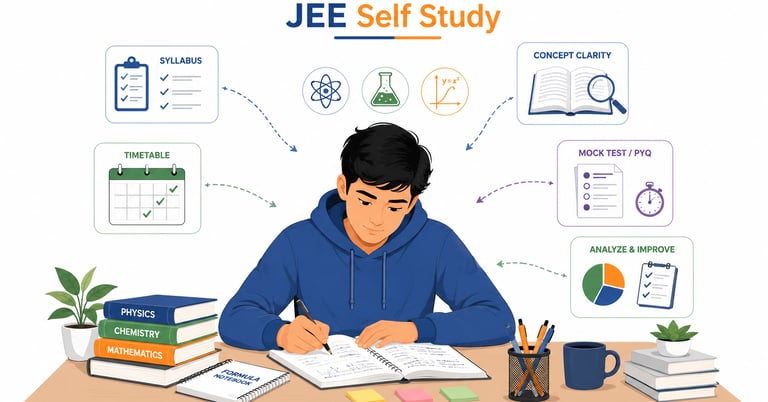
The 5-Step Self Study System for JEE Mains 2026
Before you open a single book, you need a system. Here it is:
# Know the Battlefield First
Download the official JEE Mains 2026 syllabus from NTA. Print it. Stick it somewhere visible. Before you study a single chapter, mark which topics carry the highest weightage.
High-weightage chapters for JEE Mains include:
- Modern Physics
- Current Electricity
- Thermodynamics
- Coordination Compounds
- Calculus
- Matrices & Determinants
Knowing this means you never waste time studying low-yield topics at the cost of high-yield ones.
# Build Your Personal Timetable (Don't Copy Someone Else's)
JEE Main 2026 topper Nimay Purohit from Gujarat said it perfectly:
> "The biggest reason for my success has been regular study and concept clarity. I spent approximately 6 to 8 hours daily on self-study."
But those 6–8 hours were his hours, built around his strengths.
Your timetable must reflect when you focus best. Don't copy a YouTube topper's schedule and feel guilty when it doesn't work. We'll give you a sample timetable below — use it as a starting template, not a rule.
# Study One Subject at a Time — Deeply
A common mistake is reading a chapter of Physics, then Chemistry, then Maths all in one sitting and retaining nothing. Toppers go deep into one topic until they can solve problems from it, then move on. Kabeer Chhillar broke every topic into smaller chunks and mastered each chunk before moving forward. Do the same.
### Test Yourself Constantly — PYQs Are Your Best Friend
This is the step most self-studiers skip — and it's the most important one. Reading theory doesn't build JEE skills. Solving problems does.
After finishing any topic, immediately solve 10–15 previous year questions (PYQs) from that topic. Then take a full mock test every week.
The pattern is:
Learn → Practice → Test → Analyse mistakes → Repeat
### Analyse Before You Move On
Bhavesh Patra from Odisha, one of 12 students to score 100 percentile in JEE Main 2026, said:
> "I believe that taking regular tests helps identify weaknesses and provides an opportunity to improve them."
The test itself is not the point. The analysis after the test is.
Every time you get a question wrong, understand why — was it a concept gap, a silly error, or a time management failure? Fix each category differently.
## Subject-Wise Self Study Strategy for JEE Mains
### ⚡ Physics — Concepts First, Numbers Second
Physics is the subject most students fear and most toppers dominate. Here's why: Physics questions in JEE Mains are concept-based, not formula-based. You cannot memorise your way through them.
Start with NCERT to build a strong foundation — yes, NCERT, not HC Verma. Once a concept is clear from NCERT, move to HC Verma for worked examples and problem variety. When you're ready for tougher numericals, DC Pandey's objective series is excellent for JEE Mains-level problems.
High priority chapters for self-study:
- Laws of Motion
- Work-Energy-Power
- Rotational Motion
- Current Electricity
- Electromagnetic Induction
- Modern Physics
- Optics
These appear every single year.
💡 Self-Study Tip for Physics: Maintain a formula notebook — not a textbook copy. Write only the formulas you keep forgetting, in your own words. Revise it every morning for 10 minutes. This alone will save you 5–10 marks.
### 🧪 Chemistry — The Highest Scoring Subject (Don't Ignore It)
Chemistry is split into three parts and each needs a different approach.
Physical Chemistry: This is numerical — treat it like Maths. Understand the concept, then drill problems. Focus on Mole Concept, Chemical Kinetics, Electrochemistry, and Equilibrium. P Bahadur or Narendra Awasthi works well here for problem practice.
Organic Chemistry: Don't memorise reactions blindly. Understand the mechanism — why does the reaction happen? Once you understand the mechanism, you can predict any question. NCERT is your foundation. OP Tandon builds on it well.
Inorganic Chemistry: This is the most NCERT-heavy section of the entire JEE Mains exam. Read NCERT line by line. Make short tables for periodic properties, coordination compounds, and p-block elements. Revise these tables weekly.
✅ Self-study advantage in Chemistry: Unlike Physics and Maths, Chemistry rewards consistent revision over raw intelligence. If you revise your Inorganic tables every week, you will score near-perfect in this section. This is where self-disciplined students beat distracted coaching students.
### 📐 Mathematics — Speed + Accuracy = Rank
Maths in JEE Mains is about two things: speed and accuracy. You can be the best mathematician in your school, but if you can't solve JEE-level Calculus in 3 minutes, your rank suffers.
Build your Maths in this order:
1. Algebra
2. Coordinate Geometry
3. Calculus
4. Vectors & 3D
5. Probability
Don't jump around. Each topic feeds the next.
For books: NCERT gives you the base. After that, Cengage Maths (G. Tewani) or RD Sharma are the most recommended for JEE Mains level. Do not buy 5 books. Finish 1 book completely — every exercise, every example — before touching a second one.
💡 The 1-Minute Rule for Maths (from a 99.98%ile topper):
> If you cannot find a method to solve a problem within 60 seconds of reading it, skip it and move on. Return to it at the end.
This one strategy alone can improve your score by 15–20 marks on exam day.